|
Sitting Bull's people break away from US
From
correspondents in Washington December 20, 2007 03:10pm
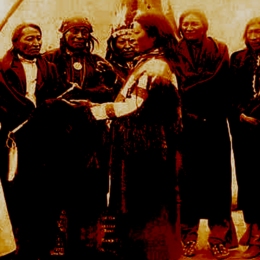
THE Lakota Indians, who gave the world legendary warriors Sitting Bull and
Crazy Horse, have withdrawn from treaties with the US.
"We are no longer citizens of the United States of America and all
those who live in the five-state area that encompasses our country are free to
join us,'' long-time Indian rights activist Russell Means said.
A delegation of Lakota leaders has delivered a message to the State
Department, and said they were unilaterally withdrawing from treaties they
signed with the federal government of the US, some of them more than 150 years
old.
The group also visited the Bolivian, Chilean, South African and Venezuelan
embassies, and would continue on their diplomatic mission and take it overseas
in the coming weeks and months.
Lakota country includes parts of the states of Nebraska, South Dakota, North
Dakota, Montana and Wyoming.
The new country would issue its own passports and driving licences, and
living there would be tax-free - provided residents renounce their US
citizenship, Mr Means said.
The treaties signed with the US were merely "worthless words on
worthless paper," the Lakota freedom activists said.
Withdrawing from the treaties was entirely legal, Means said. "This is
according to the laws of the United States, specifically article six of the
constitution,'' which states that treaties are the supreme law of the land, he
said.
``It is also within the laws on treaties passed at the Vienna Convention and
put into effect by the US and the rest of the international community in 1980.
We are legally within our rights to be free and independent,'' said Means.
The Lakota relaunched their journey to freedom in 1974, when they drafted a
declaration of continuing independence -- an overt play on the title of the
United States' Declaration of Independence from England.
Thirty-three years have elapsed since then because ``it takes critical mass
to combat colonialism and we wanted to make sure that all our ducks were in a
row,'' Means said.
One duck moved into place in September, when the United Nations adopted a
non-binding declaration on the rights of indigenous peoples -- despite
opposition from the United States, which said it clashed with its own laws.
``We have 33 treaties with the United States that they have not lived by.
They continue to take our land, our water, our children,'' Phyllis Young, who
helped organize the first international conference on indigenous rights in
Geneva in 1977, told the news conference.
The US ``annexation'' of native American land has resulted in once proud
tribes such as the Lakota becoming mere ``facsimiles of white people,'' said
Means.
Oppression at the hands of the US government has taken its toll on the
Lakota, whose men have one of the shortest life expectancies - less than 44
years - in the world.
Lakota teen suicides are 150 per cent above the norm for the US; infant
mortality is five times higher than the US average; and unemployment is rife,
according to the Lakota freedom movement's website.
|